Powered by Quotezone
Insurance comparison information
Prudent Plus Limited is an Introducer Appointed Representative of Seopa Ltd, Floor 4, Blackstaff Studios, 8-10 Amelia Street, Belfast, BT2 7GS. Seopa Ltd is authorised and regulated by the Financial Conduct Authority, FRN 313860. Quotezone is a trading style of Seopa Ltd and provides the insurance comparison service.
Prudent Plus Limited may receive a commission if a policy is purchased following an introduction, at no additional cost to you. We do not provide personal insurance advice.
Hidden leaks are among the most frustrating problems in plumbing. They waste water, damage property, and often go unnoticed until they’ve caused real harm. Traditional methods; listening devices, pressure drops, or exploratory cutting; still work, but technology has added a new ally: thermal imaging. For plumbers, it’s become one of the most reliable and time-saving diagnostic tools around.
How Thermal Imaging Works
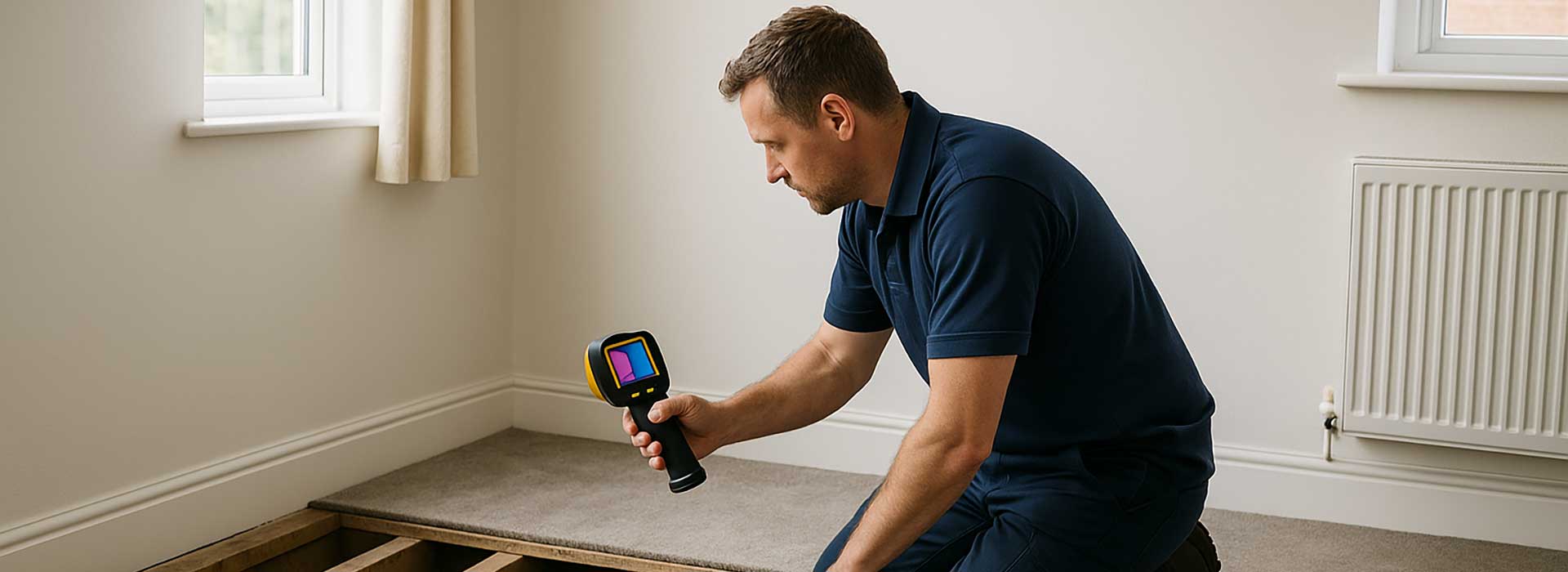
Thermal imaging cameras detect differences in surface temperature. When water escapes from a pipe, it changes the temperature of surrounding materials; sometimes cooling, sometimes heating, depending on the system. The camera converts those temperature variations into a colour image, allowing you to “see” patterns invisible to the eye.
In practice, that means tracing warm or cold water lines behind walls, under floors, or across ceilings without cutting anything open. It’s fast, clean, and surprisingly accurate once you learn to interpret what the camera shows.
Common Uses in Plumbing
Thermal imaging has applications across all types of plumbing work. The most frequent include:
- Locating hidden leaks: Quickly pinpoint pipework failures beneath floors or behind plaster before structural damage spreads.
- Tracing underfloor heating circuits: Map loops accurately, check for cold spots, and confirm even heat distribution.
- Checking radiator performance: Identify partial blockages, air locks, or sludge build-up by comparing heat spread across panels.
- Monitoring hot water and heating flow: Confirm whether return pipes are too hot or whether circulation pumps are performing properly.
- Detecting insulation faults: Reveal areas where heat escapes through poor lagging or missing insulation on pipework runs.
Because thermal cameras give instant feedback, they also help with customer confidence. You can show the issue in real time, which helps explain both the cause and the need for repair.
Choosing the Right Equipment
Not every thermal camera suits plumbing. A good entry-level model will have enough resolution to pick out pipe runs clearly and a sensitivity fine enough to show a few degrees’ difference in temperature. Key things to look for include:
- Resolution: Aim for at least 160×120 pixels. The higher the resolution, the easier it is to interpret details.
- Temperature range: For domestic work, –10°C to 150°C is usually sufficient.
- Focus and refresh rate: A responsive camera gives smoother results when moving across surfaces.
- Portability: Handheld models or smartphone attachments are ideal for day-to-day jobs. Larger systems suit surveyors and commercial sites.
Some plumbers start with a smartphone thermal add-on like the FLIR One or Seek Thermal before upgrading to a dedicated unit. These compact devices still deliver good accuracy for most domestic work.
Techniques for Accurate Results
Interpreting images takes practice. A bright patch doesn’t always mean a leak; sometimes it’s simply a heating pipe doing its job. Here are a few habits that help:
- Run the system first so temperature differences stand out clearly.
- Compare both hot and cold circuits to understand the normal pattern.
- Mark areas of concern and double-check them with moisture meters before cutting.
- Use the camera slowly; moving too quickly can blur gradients and hide small anomalies.
- Check insulation or draughts nearby that might distort readings.
In most cases, a thermal image narrows the search to a few inches; saving hours of trial and error. Combined with pressure testing, it provides both proof and precision.
Benefits for Plumbers and Clients
For plumbers, the biggest advantage is time. A single inspection can locate the source of a leak without lifting floors or damaging tiles. That means faster fixes, less mess, and happier customers. It also reinforces your professionalism; clients see that you use advanced tools and trust your diagnosis.
Over time, thermal imaging also reduces call-backs. When you can verify repairs visually, you’re less likely to miss a secondary issue. It’s a good selling point for insurance work, property surveys, or letting-agent maintenance contracts.
Limitations and Realistic Expectations
Thermal imaging isn’t magic. It can’t see through walls in the Hollywood sense, and it works best when there’s a clear temperature difference between the leak and its surroundings. In very small or slow leaks, especially on cold pipework, results can be subtle. That’s why it’s best used alongside other methods such as moisture detection or pressure testing.
Lighting conditions and reflective surfaces can also affect accuracy. Metal pipe clips, for instance, may show false readings because they conduct heat differently from the wall behind them. Understanding these quirks just takes practice and comparison.
Making It Part of Your Service
Once you’re comfortable using a thermal camera, it becomes a selling point. You can include leak detection or system health checks as premium services. Add a short section on your website explaining that you use non-invasive thermal diagnostics; it sets you apart from trades who still rely solely on guesswork.
Keep a few sample images (with permission) to show customers how clearly leaks can appear. A visual demonstration often earns immediate trust.
Summary
Thermal imaging has changed the way plumbers approach leak detection. It’s quick, clean, and impressively precise when used properly. While it doesn’t replace experience or good judgement, it adds another layer of professionalism to your toolkit. For those willing to learn, a single device can save hours on every tricky leak; and prove to customers that you take diagnosis as seriously as repair.